The Cerebral Cortex: Layers and Roles
The Cerebral Cortex: Layers and Roles
The cerebral cortex is one of the most extraordinary features of the human brain — a thin, wrinkled sheet of neural tissue that covers the outermost layer of the cerebrum. Despite being only a few millimeters thick, it contains billions of neurons and is responsible for many of the advanced mental abilities that make us human. This outer layer is what allows us to think, learn, imagine, create, and experience the world through our senses. In this article, we’ll explore how the cortex is structured, what its layers do, and why it’s crucial for nearly every thought and action we perform.
Understanding the Structure
The term “cortex” comes from the Latin word for “bark,” reflecting its position as the brain’s outer covering. Although it appears small in size, if unfolded, the cortex would stretch out to cover roughly two and a half square feet — about the size of a large dinner napkin. The folds (gyri) and grooves (sulci) increase the surface area, allowing more neurons to fit inside the skull and making our brains more efficient.
The cerebral cortex is divided into two halves — the left and right hemispheres — which are connected by a thick bundle of nerve fibers called the corpus callosum. These two hemispheres work together constantly, sharing information and ensuring that both sides of the body and mind remain synchronized. For example, the left hemisphere often specializes in analytical and language-related tasks, while the right side focuses more on creativity, spatial awareness, and emotional interpretation.
The Six Layers of the Cortex
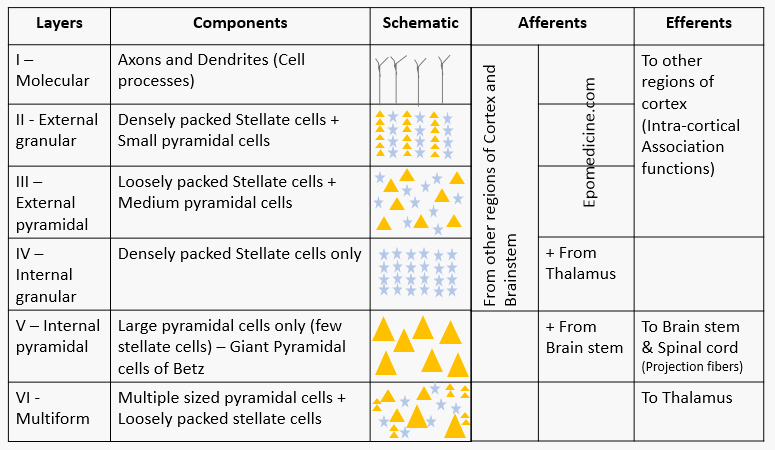
One of the most fascinating aspects of the cerebral cortex is its organization into **six distinct layers**, each containing different types of neurons and serving specific purposes. These layers aren’t visible to the naked eye but can be seen under a microscope. Together, they form complex circuits that allow sensory input, motor control, and higher reasoning to work seamlessly.
Layer I – Molecular Layer: The outermost layer, which contains very few neurons. It serves mainly as a communication zone where fibers from other parts of the brain connect and interact.
Layer II – External Granular Layer: Contains small neurons responsible for processing information received from nearby cortical areas.
Layer III – External Pyramidal Layer: Holds medium-sized pyramidal neurons that send messages to other parts of the cortex, helping integrate information across regions.
Layer IV – Internal Granular Layer: Acts as a major input layer, receiving sensory signals from the thalamus — the brain’s “relay station.” It’s particularly thick in sensory regions like the visual or auditory cortex.
Layer V – Internal Pyramidal Layer: Contains large pyramidal neurons (such as Betz cells) that send signals to the brainstem and spinal cord to control voluntary movement.
Layer VI – Multiform Layer: The deepest layer, connecting the cortex back to the thalamus and helping regulate incoming and outgoing signals.
These layers together ensure that the brain can receive, interpret, and respond to information in milliseconds — a beautiful example of biological efficiency and precision.
Functional Areas of the Cortex
The cerebral cortex is not uniform. Different areas are specialized for particular functions, though they constantly communicate with one another.
1. Sensory Areas: These regions process input from the senses — vision, hearing, touch, taste, and smell. For instance, the visual cortex in the occipital lobe interprets light and color, while the auditory cortex in the temporal lobe processes sound.
2. Motor Areas: Located mainly in the frontal lobe, these areas control voluntary muscle movements. When you decide to raise your hand or smile, neurons in the motor cortex send precise instructions to your muscles.
3. Association Areas: These areas integrate information from sensory and motor regions, allowing us to understand, plan, and act. They support advanced functions such as language, problem-solving, and abstract thinking.
Everyday Examples of Cortical Function
Consider how the cortex works during simple actions. When you read a book, the visual cortex decodes the letters and words, the temporal cortex interprets meaning, the frontal cortex formulates responses, and association areas link the story to your memory and emotions. The cortex doesn’t work in isolation — it collaborates across multiple lobes to create understanding, emotion, and movement.
Another example is playing a musical instrument. The motor cortex controls your hands and fingers, the auditory cortex helps you listen and adjust to sound, and association areas refine timing and rhythm. Even creativity and emotional expression during performance involve communication between cortical and subcortical regions.
The Cortex and Higher Thinking
The cerebral cortex is essential for higher-order functions that define human intelligence. It’s where reasoning, language, imagination, and self-awareness take shape. For instance, the prefrontal cortex enables us to plan ahead, solve problems, and anticipate outcomes — skills that evolved to help humans adapt and survive. Scientists believe that the expansion of the cortex in humans, compared to other species, is what gives us advanced cognitive flexibility and emotional depth.
Protecting the Cerebral Cortex
Because the cortex handles critical functions, protecting it from injury is crucial. Wearing helmets during physical activity, getting enough rest, and avoiding substance abuse can preserve cortical health. Mental exercises like reading, learning a new language, or practicing mindfulness can strengthen cortical connections and improve neuroplasticity — the brain’s ability to adapt and grow new pathways. A healthy diet rich in omega-3 fatty acids and antioxidants also supports cortical performance over time.
Every time we learn, think, or recall a memory, we’re witnessing the cortex at work. Its complex yet elegant architecture is a reminder of how extraordinary the human brain truly is.
Key Takeaways
- The cerebral cortex: The brain’s thin outer layer responsible for advanced thinking, learning, and perception. It’s divided into two hemispheres and covers the cerebrum like a wrinkled sheet.
- Six layers: Each cortical layer has specialized neurons that receive, process, and send signals. Together, they enable everything from sensing to movement and reasoning.
- Functional regions: The cortex has sensory, motor, and association areas that interpret information, coordinate actions, and integrate experiences into meaningful understanding.
- Example: When reading a sentence, your visual cortex recognizes the letters, your temporal cortex understands their meaning, and your frontal cortex helps form a response.
- Collaboration across lobes: The cortex doesn’t act alone — it works alongside other lobes to manage speech, memory, and creativity in a coordinated system.
- Healthy brain habits: Engaging in mental challenges, physical exercise, proper sleep, and balanced nutrition preserves cortical function and enhances memory and focus.
- Analogy: Think of the cortex as the “control panel” of the brain — a place where sensory data, thoughts, and actions are processed, connected, and transformed into human experience.
- Awareness: Understanding how the cortex operates deepens appreciation for the brain’s complexity and encourages mindful care of this remarkable structure.
Disclaimer: These pages are for education only and do not replace professional advice.